> ## Documentation Index
> Fetch the complete documentation index at: https://docs.crossmint.com/llms.txt
> Use this file to discover all available pages before exploring further.
# How Agents Pay
> Learn why agents need to pay and how they can make payments.
Agents operate across two distinct economies:
* **The traditional web runs on cards**. Amazon, Shopify stores, SaaS checkouts, and most traditional merchants rely on card payments. Users expect familiar properties like card rewards, refunds, and chargebacks.
* **The agentic web runs on stablecoins**. x402 and MPP-gated APIs, micropayments, and machine-to-machine settlement require stablecoins. Cards don’t work here since fees, chargebacks, and merchant account constraints make small or programmatic payments impractical.
Most agents need both so **Crossmint provides cards and stablecoin wallets as first-class primitives.**
## Payment methods need spending rules
You cannot give an agent unrestricted access to money:
* Credentials can be leaked
* Agents can overspend or behave unexpectedly
An agent with unlimited access is a liability. The goal is not just "agents can pay", it is "agents can pay securely without exposing sensitive data."
Each payment method enforces this differently:
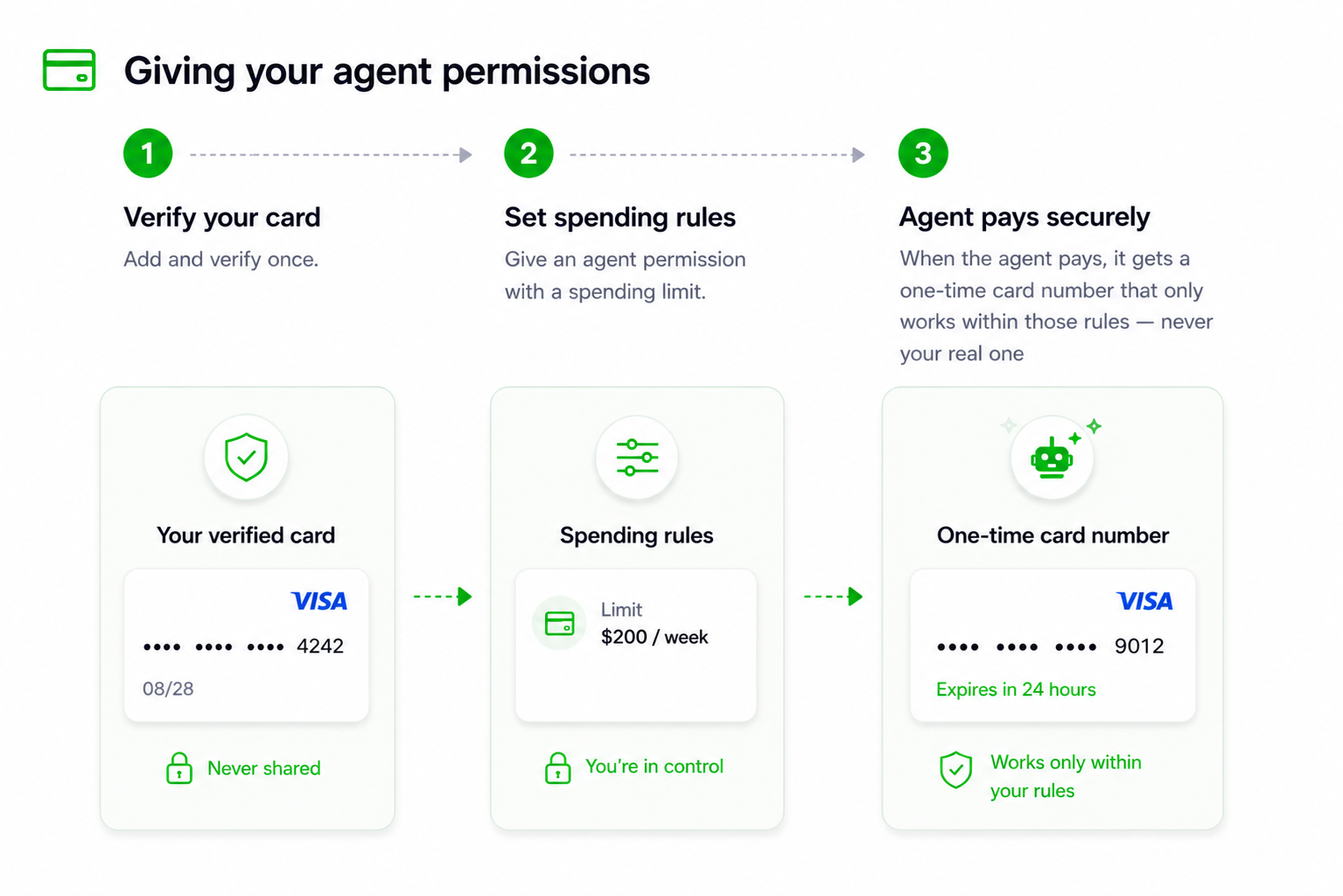
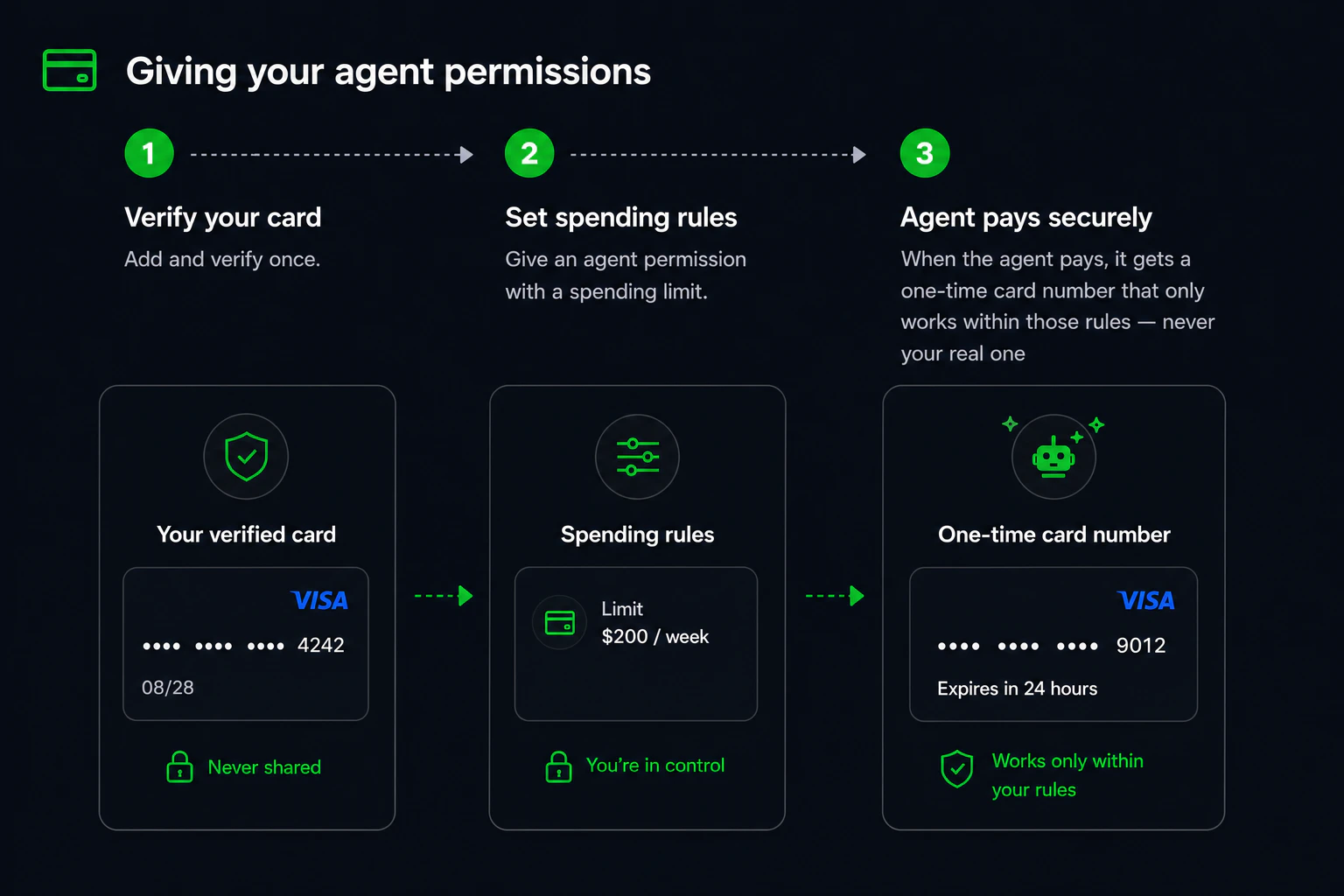
* **Card agentic protocols**. The user’s real card is stored in a PCI-compliant vault. Users give agents **permissions** to use their card with spending rules (amount, merchant, duration), enforced at the network level via Visa VIC and Mastercard Agent Pay. The agent never sees the real card number — developers **never** handle sensitive information.
Each card permission has two time dimensions: the **period** controls how often the spending limit resets (for example, weekly or monthly), while the **expiry** (`expiresAt`) controls when the permission itself stops working. These are independent — a monthly spending limit does not automatically keep the permission alive for a month. If no expiry is set, the permission defaults to seven days. See [Give Card Permission](/agents/payment-methods/cards/create-card-permissions) for details.
 * **Wallet non-custodial delegation**. The user owns the wallet and grants the agent scoped permissions (spend limit, counterparties, time window). Developers and agents never take custody of funds.
## User flows
Every payment method an agent uses is set up through a user flow — a hosted, customizable UI where the user explicitly delegates access. The flows below cover the end to end integration steps for both cards and wallets.
One principle holds across all of them: **the user stays in control.** Every delegation is explicit, scoped, and revocable. Crossmint provides the UI components and signing flows. You wire them into your product.
Via a Crossmint-hosted secure iframe.
This step links the card to the agentic card rails.
* Happens in a Crossmint component
* User verifies ownership (e.g. email code or bank auth)
* A passkey is created for future approvals
The developer requests a card permission with spending rules (amount, merchant, expiration). A network modal (Visa/Mastercard) appears and the user confirms using their passkey.
Each approved payment returns a **secure one-time card number** that only works within the spending rules — never the real card number. The agent uses it in browser checkout or APIs.
Created via the Crossmint SDK. The user retains ownership — Crossmint and the developer never take custody. Funded by direct transfer or fiat onramp.
The agent gets its own key and is added as a **signer** on the user's wallet, bound to a permission set the user signs off on:
* **Spend cap** — max amount the agent can move
* **Allowed counterparties** — addresses or protocols the agent can interact with
* **Time window** — when the delegation is valid
Permissions are enforced onchain. The user can revoke at any time.
The agent signs and submits transactions with its own key — no user prompt per action. Anything outside the delegated scope is rejected at the wallet level.
## How agents actually pay
Once setup is complete, agents can spend. The payment flow depends on *where* they are paying.
| Flow | Payment method | How it works | Best for |
| ----------------------------------------------------------- | ------------------ | ------------------------------------------------------------------------------------- | -------------------------------- |
| [x402](/agents/payment-flows/x402) | Stablecoin | Agent calls an endpoint, receives `402 Payment Required`, pays in stablecoin, retries | Pay-per-call APIs, micropayments |
| [MPP](/agents/payment-flows/mpp) | Stablecoin | Agent-to-agent and service-to-service payments over a payment protocol | Programmatic machine economies |
| [Browser Checkout](/agents/payment-flows/browser-checkout) | Card | Agent drives a real browser and fills checkout forms using a secure card number | Any website that accepts cards |
| [Fast Checkout](/agents/payment-flows/worldstore/inventory) | Card or stablecoin | A single API call replaces the entire checkout flow — no browser needed | Amazon, Shopify stores (US only) |
## Choose Your Path
Build an agent paying with card permissions.
Build an agent paying with stablecoins.
* **Wallet non-custodial delegation**. The user owns the wallet and grants the agent scoped permissions (spend limit, counterparties, time window). Developers and agents never take custody of funds.
## User flows
Every payment method an agent uses is set up through a user flow — a hosted, customizable UI where the user explicitly delegates access. The flows below cover the end to end integration steps for both cards and wallets.
One principle holds across all of them: **the user stays in control.** Every delegation is explicit, scoped, and revocable. Crossmint provides the UI components and signing flows. You wire them into your product.
Via a Crossmint-hosted secure iframe.
This step links the card to the agentic card rails.
* Happens in a Crossmint component
* User verifies ownership (e.g. email code or bank auth)
* A passkey is created for future approvals
The developer requests a card permission with spending rules (amount, merchant, expiration). A network modal (Visa/Mastercard) appears and the user confirms using their passkey.
Each approved payment returns a **secure one-time card number** that only works within the spending rules — never the real card number. The agent uses it in browser checkout or APIs.
Created via the Crossmint SDK. The user retains ownership — Crossmint and the developer never take custody. Funded by direct transfer or fiat onramp.
The agent gets its own key and is added as a **signer** on the user's wallet, bound to a permission set the user signs off on:
* **Spend cap** — max amount the agent can move
* **Allowed counterparties** — addresses or protocols the agent can interact with
* **Time window** — when the delegation is valid
Permissions are enforced onchain. The user can revoke at any time.
The agent signs and submits transactions with its own key — no user prompt per action. Anything outside the delegated scope is rejected at the wallet level.
## How agents actually pay
Once setup is complete, agents can spend. The payment flow depends on *where* they are paying.
| Flow | Payment method | How it works | Best for |
| ----------------------------------------------------------- | ------------------ | ------------------------------------------------------------------------------------- | -------------------------------- |
| [x402](/agents/payment-flows/x402) | Stablecoin | Agent calls an endpoint, receives `402 Payment Required`, pays in stablecoin, retries | Pay-per-call APIs, micropayments |
| [MPP](/agents/payment-flows/mpp) | Stablecoin | Agent-to-agent and service-to-service payments over a payment protocol | Programmatic machine economies |
| [Browser Checkout](/agents/payment-flows/browser-checkout) | Card | Agent drives a real browser and fills checkout forms using a secure card number | Any website that accepts cards |
| [Fast Checkout](/agents/payment-flows/worldstore/inventory) | Card or stablecoin | A single API call replaces the entire checkout flow — no browser needed | Amazon, Shopify stores (US only) |
## Choose Your Path
Build an agent paying with card permissions.
Build an agent paying with stablecoins.