> ## Documentation Index
> Fetch the complete documentation index at: https://docs.crossmint.com/llms.txt
> Use this file to discover all available pages before exploring further.
# Verify Webhooks
> Verify the signature and timestamp when processing webhooks
Because of the way webhooks work, attackers can impersonate services by simply sending a fake webhook to an endpoint. Think about it: it’s just an HTTP POST from an unknown source. This can create a potential security vulnerability for many applications, or at the very least, a source of errors.
To prevent this, Crossmint signs every webhook and its metadata with a unique key for each endpoint. Use this signature to verify that the webhook indeed comes from Crossmint, and process it only if it does.
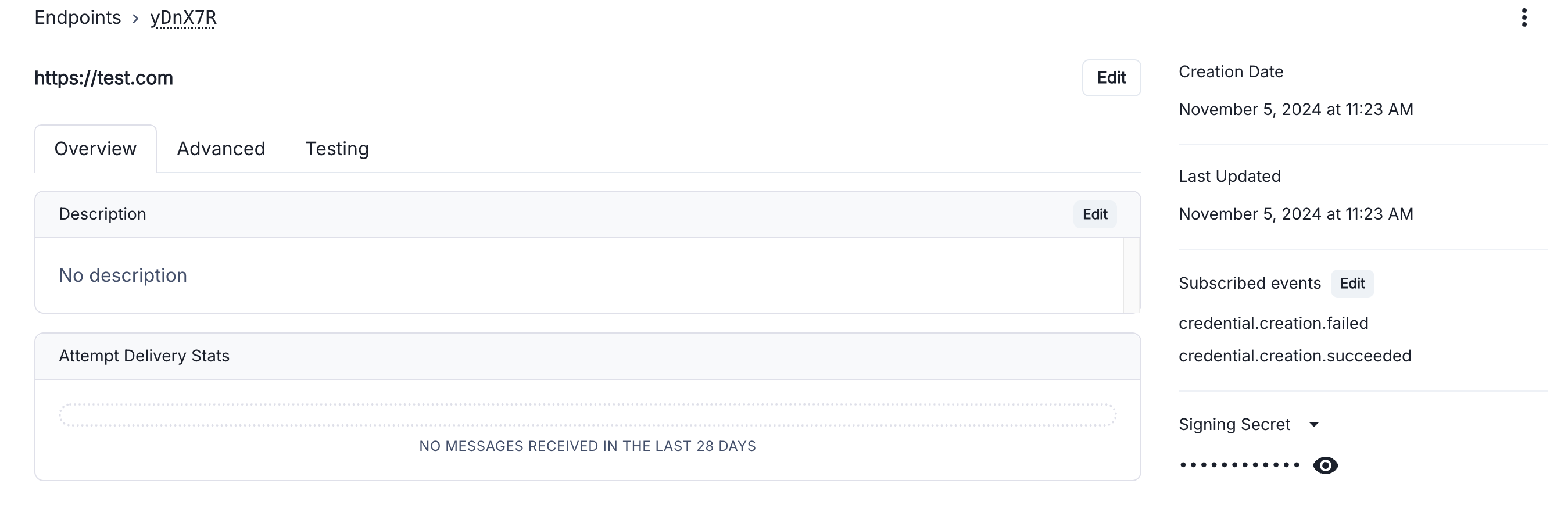
You can get the signing key secret from the Webhooks page in the console. To find it, go to the endpoint details and look for the Signing Secret section.
 We are going to use the Svix open-source library to verify webhooks. First, install the relevant libraries for your language:
```js JavaScript theme={null}
npm install svix
// Or
yarn add svix
```
```python Python theme={null}
pip install svix
```
```rust Rust theme={null}
http = "1.0.0"
svix = "1.20.0"
```
```go Go theme={null}
go get github.com/svix/svix-webhooks/go
```
```java Java theme={null}
// Gradle: Add this dependency to your project's build file:
implementation "com.svix:svix:0.x.y"
// Maven: Add this dependency to your project's POM file:
com.svix
svix
0.x.y
```
```kotlin Kotlin theme={null}
// Gradle: Add this dependency to your project's build file:
implementation "com.svix.kotlin:svix-kotlin:0.x.y"
// Maven: Add this dependency to your project's POM file:
com.svix.kotlin
svix-kotlin
0.x.y
```
```ruby Ruby theme={null}
gem install svix
```
```csharp C# theme={null}
dotnet add package Svix
```
```php PHP theme={null}
composer require svix/svix
```
```bash CLI theme={null}
# On macOS install via Homebrew:
brew install svix/svix/svix
# On Linux install via Scoop:
scoop bucket add svix https://github.com/svix/scoop-svix.git
scoop install svix
```
Next, verify webhooks using the code below. The payload is the raw (string) body of the request, and the headers are the headers passed in the request.
You need to use the **raw request body** when verifying webhooks, as the cryptographic signature is sensitive to even the slightest changes. Watch out for frameworks that parse the request as JSON and then stringify it, as this will break the signature verification.
See examples below for how to get the raw request body with different frameworks.
Remember to get the signature secret from the endpoint details in the console.
```js JavaScript theme={null}
import { Webhook } from "svix";
const secret = "whsec_MfKQ9r8GKYqrTwjUPD8ILPZIo2LaLaSw";
// These were all sent from the server
const headers = {
"svix-id": "msg_p5jXN8AQM9LWM0D4loKWxJek",
"svix-timestamp": "1614265330",
"svix-signature": "v1,g0hM9SsE+OTPJTGt/tmIKtSyZlE3uFJELVlNIOLJ1OE=",
};
const payload = '{"test": 2432232314}';
const wh = new Webhook(secret);
// Throws on error, returns the verified content on success
const payload = wh.verify(payload, headers);
```
```python Python theme={null}
from svix.webhooks import Webhook
secret = "whsec_MfKQ9r8GKYqrTwjUPD8ILPZIo2LaLaSw"
# These were all sent from the server
headers = {
"svix-id": "msg_p5jXN8AQM9LWM0D4loKWxJek",
"svix-timestamp": "1614265330",
"svix-signature": "v1,g0hM9SsE+OTPJTGt/tmIKtSyZlE3uFJELVlNIOLJ1OE=",
}
payload = '{"test": 2432232314}'
wh = Webhook(secret)
# Throws on error, returns the verified content on success
payload = wh.verify(payload, headers)
```
```rust Rust theme={null}
use svix::webhooks::Webhook;
let secret = "whsec_MfKQ9r8GKYqrTwjUPD8ILPZIo2LaLaSw".to_string();
let mut headers = http::HeaderMap::new();
headers.insert("svix-id", "msg_p5jXN8AQM9LWM0D4loKWxJek");
headers.insert("svix-timestamp", "1614265330");
headers.insert(
"svix-signature",
"v1,g0hM9SsE+OTPJTGt/tmIKtSyZlE3uFJELVlNIOLJ1OE=",
);
let payload = b"{\"test\": 2432232314}";
let wh = Webhook::new(&secret)?;
wh.verify(&payload, &headers)?;
// returns Ok on success, Err otherwise
```
```go Go theme={null}
import (
svix "github.com/svix/svix-webhooks/go"
)
secret := "whsec_MfKQ9r8GKYqrTwjUPD8ILPZIo2LaLaSw"
// These were all sent from the server
headers := http.Header{}
headers.Set("svix-id", "msg_p5jXN8AQM9LWM0D4loKWxJek")
headers.Set("svix-timestamp", "1614265330")
headers.Set("svix-signature", "v1,g0hM9SsE+OTPJTGt/tmIKtSyZlE3uFJELVlNIOLJ1OE=")
payload := []byte(`{"test": 2432232314}`)
wh, err := svix.NewWebhook(secret)
err := wh.Verify(payload, headers)
// returns nil on success, error otherwise
```
```java Java theme={null}
import com.svix.Webhook;
String secret = "whsec_MfKQ9r8GKYqrTwjUPD8ILPZIo2LaLaSw";
// These were all sent from the server
HashMap> headerMap = new HashMap>();
headerMap.put("svix-id", Arrays.asList("msg_p5jXN8AQM9LWM0D4loKWxJek"));
headerMap.put("svix-timestamp", Arrays.asList("1614265330"));
headerMap.put("svix-signature", Arrays.asList("v1,g0hM9SsE+OTPJTGt/tmIKtSyZlE3uFJELVlNIOLJ1OE="));
HttpHeaders headers = HttpHeaders.of(headerMap, BiPredicate)
String payload = "{\"test\": 2432232314}";
Webhook webhook = new Webhook(secret);
webhook.verify(payload, headers)
// throws WebhookVerificationError exception on failure.
```
```kotlin Kotlin theme={null}
import com.svix.kotlin.Webhook
val secret = "whsec_MfKQ9r8GKYqrTwjUPD8ILPZIo2LaLaSw";
// These were all sent from the server
val headersMap = mapOf(
"svix-id" to listOf("msg_p5jXN8AQM9LWM0D4loKWxJek"),
"svix-timestamp" to listOf("1614265330"),
"svix-signature" to listOf("v1,g0hM9SsE+OTPJTGt/tmIKtSyZlE3uFJELVlNIOLJ1OE=")
)
val headers = HttpHeaders.of(headersMap) { _, _ -> true }
val payload = "{\"test\": 2432232314}";
val webhook = Webhook(secret);
webhook.verify(payload, headers)
// throws WebhookVerificationError exception on failure.
```
```ruby Ruby theme={null}
require 'svix'
# These were all sent from the server
headers = {
"svix-id" => "msg_p5jXN8AQM9LWM0D4loKWxJek",
"svix-timestamp" => "1614265330",
"svix-signature" => "v1,g0hM9SsE+OTPJTGt/tmIKtSyZlE3uFJELVlNIOLJ1OE="
}
payload = '{"test": 2432232314}'
wh = Svix::Webhook.new("whsec_MfKQ9r8GKYqrTwjUPD8ILPZIo2LaLaSw")
# Raises on error, returns the verified content on success
json = wh.verify(payload, headers)
```
```csharp C# theme={null}
using Svix;
using System.Net;
// These were all sent from the server
var headers = new WebHeaderCollection();
headers.Set("svix-id", "msg_p5jXN8AQM9LWM0D4loKWxJek");
headers.Set("svix-timestamp", "1614265330");
headers.Set("svix-signature", "v1,g0hM9SsE+OTPJTGt/tmIKtSyZlE3uFJELVlNIOLJ1OE=");
var payload = "{\"test\": 2432232314}";
var wh = new Webhook("whsec_MfKQ9r8GKYqrTwjUPD8ILPZIo2LaLaSw/Je4ZJEGP1QFb");
// Throws on error
wh.Verify(payload, headers);
```
```php PHP theme={null}
// import using composers autoload
require_once('vendor/autoload.php');
// or manually
require_once('/path/to/svix/php/init.php');
// These were all sent from the server
$payload = '{"test": 2432232314}';
$header = array(
'svix-id' => 'msg_p5jXN8AQM9LWM0D4loKWxJek',
'svix-timestamp' => '1614265330',
'svix-signature' => 'v1,g0hM9SsE+OTPJTGt/tmIKtSyZlE3uFJELVlNIOLJ1OE=',
);
// Throws on error, returns the verified content on success
$wh = new \Svix\Webhook('whsec_MfKQ9r8GKYqrTwjUPD8ILPZIo2LaLaSw');
$json = $wh->verify($payload, $header);
```
```bash CLI theme={null}
export SVIX_AUTH_TOKEN="AUTH_TOKEN"
svix verify --secret whsec_MfKQ9r8GKYqrTwjUPD8ILPZIo2LaLaSw --msg-id msg_p5jXN8AQM9LWM0D4loKWxJek --timestamp 1614265330 --signature v1,g0hM9SsE+OTPJTGt/tmIKtSyZlE3uFJELVlNIOLJ1OE= '{"test": 2432232314}'
```
This is a manual verification process. We recommend using a library to verify webhooks automatically.
If you need to verify manually, follow these instructions.
Each webhook call includes three headers with additional information that are used for verification:
* `svix-id`: The unique message identifier for the webhook message. This identifier is unique across all messages, but will be the same when the same webhook is resent (e.g., due to a previous failure).
* `svix-timestamp`: Timestamp in seconds since epoch.
* `svix-signature`: The Base64 encoded list of signatures (space delimited).
### Constructing the Signed Content
The content to sign is composed by concatenating the ID, timestamp, and payload, separated by the full-stop character (`.`). In code, it will look something like this:
```js theme={null}
const signedContent = `${svix_id}.${svix_timestamp}.${body}`;
```
Where `body` is the raw body of the request. The signature is sensitive to any changes, so even a small change in the body will cause the signature to be completely different. This means that you should not change the body in any way before verifying.
Ensure you use the **raw request body** for verification. Parsing and re-stringifying JSON will alter the content and cause verification failure.
### Determining the Expected Signature
We use HMAC with SHA-256 to sign webhooks.
To calculate the expected signature, HMAC the `signedContent` from above using the base64 portion of your signing secret (this is the part after the `whsec_` prefix) as the key. For example, if your secret is `whsec_MfKQ9r8GKYqrTwjUPD8ILPZIo2LaLaSw`, use `MfKQ9r8GKYqrTwjUPD8ILPZIo2LaLaSw`.
For example, this is how you can calculate the signature in Node.js:
```js theme={null}
const crypto = require('crypto');
const signedContent = `${svix_id}.${svix_timestamp}.${body}`;
const secret = "whsec_5WbX5kEWLlfzsGNjH64I8lOOqUB6e8FH";
// Need to base64 decode the secret
const secretBytes = Buffer.from(secret.split('_')[1], "base64");
const signature = crypto
.createHmac('sha256', secretBytes)
.update(signedContent)
.digest('base64');
console.log(signature);
```
This generated signature should match one of the ones sent in the `svix-signature` header.
The `svix-signature` header is a list of space-delimited signatures with version identifiers. The list is typically one item but can contain multiple signatures, like this:
```
v1,g0hM9SsE+OTPJTGt/tmIKtSyZlE3uFJELVlNIOLJ1OE= v1,bm9ldHUjKzFob2VudXRob2VodWUzMjRvdWVvdW9ldQo= v2,MzJsNDk4MzI0K2VvdSMjMTEjQEBAQDEyMzMzMzEyMwo=
```
Make sure to remove the version prefix and delimiter (e.g. `v1,`) before verifying the signature.
Please note that to compare the signatures it's recommended to use a constant-time string comparison method in order to prevent timing attacks.
### Verify timestamp
We include the timestamp of the attempt in the `svix-timestamp` header. Compare this timestamp against your system timestamp to ensure it’s within an acceptable tolerance to prevent replay attacks.
We are going to use the Svix open-source library to verify webhooks. First, install the relevant libraries for your language:
```js JavaScript theme={null}
npm install svix
// Or
yarn add svix
```
```python Python theme={null}
pip install svix
```
```rust Rust theme={null}
http = "1.0.0"
svix = "1.20.0"
```
```go Go theme={null}
go get github.com/svix/svix-webhooks/go
```
```java Java theme={null}
// Gradle: Add this dependency to your project's build file:
implementation "com.svix:svix:0.x.y"
// Maven: Add this dependency to your project's POM file:
com.svix
svix
0.x.y
```
```kotlin Kotlin theme={null}
// Gradle: Add this dependency to your project's build file:
implementation "com.svix.kotlin:svix-kotlin:0.x.y"
// Maven: Add this dependency to your project's POM file:
com.svix.kotlin
svix-kotlin
0.x.y
```
```ruby Ruby theme={null}
gem install svix
```
```csharp C# theme={null}
dotnet add package Svix
```
```php PHP theme={null}
composer require svix/svix
```
```bash CLI theme={null}
# On macOS install via Homebrew:
brew install svix/svix/svix
# On Linux install via Scoop:
scoop bucket add svix https://github.com/svix/scoop-svix.git
scoop install svix
```
Next, verify webhooks using the code below. The payload is the raw (string) body of the request, and the headers are the headers passed in the request.
You need to use the **raw request body** when verifying webhooks, as the cryptographic signature is sensitive to even the slightest changes. Watch out for frameworks that parse the request as JSON and then stringify it, as this will break the signature verification.
See examples below for how to get the raw request body with different frameworks.
Remember to get the signature secret from the endpoint details in the console.
```js JavaScript theme={null}
import { Webhook } from "svix";
const secret = "whsec_MfKQ9r8GKYqrTwjUPD8ILPZIo2LaLaSw";
// These were all sent from the server
const headers = {
"svix-id": "msg_p5jXN8AQM9LWM0D4loKWxJek",
"svix-timestamp": "1614265330",
"svix-signature": "v1,g0hM9SsE+OTPJTGt/tmIKtSyZlE3uFJELVlNIOLJ1OE=",
};
const payload = '{"test": 2432232314}';
const wh = new Webhook(secret);
// Throws on error, returns the verified content on success
const payload = wh.verify(payload, headers);
```
```python Python theme={null}
from svix.webhooks import Webhook
secret = "whsec_MfKQ9r8GKYqrTwjUPD8ILPZIo2LaLaSw"
# These were all sent from the server
headers = {
"svix-id": "msg_p5jXN8AQM9LWM0D4loKWxJek",
"svix-timestamp": "1614265330",
"svix-signature": "v1,g0hM9SsE+OTPJTGt/tmIKtSyZlE3uFJELVlNIOLJ1OE=",
}
payload = '{"test": 2432232314}'
wh = Webhook(secret)
# Throws on error, returns the verified content on success
payload = wh.verify(payload, headers)
```
```rust Rust theme={null}
use svix::webhooks::Webhook;
let secret = "whsec_MfKQ9r8GKYqrTwjUPD8ILPZIo2LaLaSw".to_string();
let mut headers = http::HeaderMap::new();
headers.insert("svix-id", "msg_p5jXN8AQM9LWM0D4loKWxJek");
headers.insert("svix-timestamp", "1614265330");
headers.insert(
"svix-signature",
"v1,g0hM9SsE+OTPJTGt/tmIKtSyZlE3uFJELVlNIOLJ1OE=",
);
let payload = b"{\"test\": 2432232314}";
let wh = Webhook::new(&secret)?;
wh.verify(&payload, &headers)?;
// returns Ok on success, Err otherwise
```
```go Go theme={null}
import (
svix "github.com/svix/svix-webhooks/go"
)
secret := "whsec_MfKQ9r8GKYqrTwjUPD8ILPZIo2LaLaSw"
// These were all sent from the server
headers := http.Header{}
headers.Set("svix-id", "msg_p5jXN8AQM9LWM0D4loKWxJek")
headers.Set("svix-timestamp", "1614265330")
headers.Set("svix-signature", "v1,g0hM9SsE+OTPJTGt/tmIKtSyZlE3uFJELVlNIOLJ1OE=")
payload := []byte(`{"test": 2432232314}`)
wh, err := svix.NewWebhook(secret)
err := wh.Verify(payload, headers)
// returns nil on success, error otherwise
```
```java Java theme={null}
import com.svix.Webhook;
String secret = "whsec_MfKQ9r8GKYqrTwjUPD8ILPZIo2LaLaSw";
// These were all sent from the server
HashMap> headerMap = new HashMap>();
headerMap.put("svix-id", Arrays.asList("msg_p5jXN8AQM9LWM0D4loKWxJek"));
headerMap.put("svix-timestamp", Arrays.asList("1614265330"));
headerMap.put("svix-signature", Arrays.asList("v1,g0hM9SsE+OTPJTGt/tmIKtSyZlE3uFJELVlNIOLJ1OE="));
HttpHeaders headers = HttpHeaders.of(headerMap, BiPredicate)
String payload = "{\"test\": 2432232314}";
Webhook webhook = new Webhook(secret);
webhook.verify(payload, headers)
// throws WebhookVerificationError exception on failure.
```
```kotlin Kotlin theme={null}
import com.svix.kotlin.Webhook
val secret = "whsec_MfKQ9r8GKYqrTwjUPD8ILPZIo2LaLaSw";
// These were all sent from the server
val headersMap = mapOf(
"svix-id" to listOf("msg_p5jXN8AQM9LWM0D4loKWxJek"),
"svix-timestamp" to listOf("1614265330"),
"svix-signature" to listOf("v1,g0hM9SsE+OTPJTGt/tmIKtSyZlE3uFJELVlNIOLJ1OE=")
)
val headers = HttpHeaders.of(headersMap) { _, _ -> true }
val payload = "{\"test\": 2432232314}";
val webhook = Webhook(secret);
webhook.verify(payload, headers)
// throws WebhookVerificationError exception on failure.
```
```ruby Ruby theme={null}
require 'svix'
# These were all sent from the server
headers = {
"svix-id" => "msg_p5jXN8AQM9LWM0D4loKWxJek",
"svix-timestamp" => "1614265330",
"svix-signature" => "v1,g0hM9SsE+OTPJTGt/tmIKtSyZlE3uFJELVlNIOLJ1OE="
}
payload = '{"test": 2432232314}'
wh = Svix::Webhook.new("whsec_MfKQ9r8GKYqrTwjUPD8ILPZIo2LaLaSw")
# Raises on error, returns the verified content on success
json = wh.verify(payload, headers)
```
```csharp C# theme={null}
using Svix;
using System.Net;
// These were all sent from the server
var headers = new WebHeaderCollection();
headers.Set("svix-id", "msg_p5jXN8AQM9LWM0D4loKWxJek");
headers.Set("svix-timestamp", "1614265330");
headers.Set("svix-signature", "v1,g0hM9SsE+OTPJTGt/tmIKtSyZlE3uFJELVlNIOLJ1OE=");
var payload = "{\"test\": 2432232314}";
var wh = new Webhook("whsec_MfKQ9r8GKYqrTwjUPD8ILPZIo2LaLaSw/Je4ZJEGP1QFb");
// Throws on error
wh.Verify(payload, headers);
```
```php PHP theme={null}
// import using composers autoload
require_once('vendor/autoload.php');
// or manually
require_once('/path/to/svix/php/init.php');
// These were all sent from the server
$payload = '{"test": 2432232314}';
$header = array(
'svix-id' => 'msg_p5jXN8AQM9LWM0D4loKWxJek',
'svix-timestamp' => '1614265330',
'svix-signature' => 'v1,g0hM9SsE+OTPJTGt/tmIKtSyZlE3uFJELVlNIOLJ1OE=',
);
// Throws on error, returns the verified content on success
$wh = new \Svix\Webhook('whsec_MfKQ9r8GKYqrTwjUPD8ILPZIo2LaLaSw');
$json = $wh->verify($payload, $header);
```
```bash CLI theme={null}
export SVIX_AUTH_TOKEN="AUTH_TOKEN"
svix verify --secret whsec_MfKQ9r8GKYqrTwjUPD8ILPZIo2LaLaSw --msg-id msg_p5jXN8AQM9LWM0D4loKWxJek --timestamp 1614265330 --signature v1,g0hM9SsE+OTPJTGt/tmIKtSyZlE3uFJELVlNIOLJ1OE= '{"test": 2432232314}'
```
This is a manual verification process. We recommend using a library to verify webhooks automatically.
If you need to verify manually, follow these instructions.
Each webhook call includes three headers with additional information that are used for verification:
* `svix-id`: The unique message identifier for the webhook message. This identifier is unique across all messages, but will be the same when the same webhook is resent (e.g., due to a previous failure).
* `svix-timestamp`: Timestamp in seconds since epoch.
* `svix-signature`: The Base64 encoded list of signatures (space delimited).
### Constructing the Signed Content
The content to sign is composed by concatenating the ID, timestamp, and payload, separated by the full-stop character (`.`). In code, it will look something like this:
```js theme={null}
const signedContent = `${svix_id}.${svix_timestamp}.${body}`;
```
Where `body` is the raw body of the request. The signature is sensitive to any changes, so even a small change in the body will cause the signature to be completely different. This means that you should not change the body in any way before verifying.
Ensure you use the **raw request body** for verification. Parsing and re-stringifying JSON will alter the content and cause verification failure.
### Determining the Expected Signature
We use HMAC with SHA-256 to sign webhooks.
To calculate the expected signature, HMAC the `signedContent` from above using the base64 portion of your signing secret (this is the part after the `whsec_` prefix) as the key. For example, if your secret is `whsec_MfKQ9r8GKYqrTwjUPD8ILPZIo2LaLaSw`, use `MfKQ9r8GKYqrTwjUPD8ILPZIo2LaLaSw`.
For example, this is how you can calculate the signature in Node.js:
```js theme={null}
const crypto = require('crypto');
const signedContent = `${svix_id}.${svix_timestamp}.${body}`;
const secret = "whsec_5WbX5kEWLlfzsGNjH64I8lOOqUB6e8FH";
// Need to base64 decode the secret
const secretBytes = Buffer.from(secret.split('_')[1], "base64");
const signature = crypto
.createHmac('sha256', secretBytes)
.update(signedContent)
.digest('base64');
console.log(signature);
```
This generated signature should match one of the ones sent in the `svix-signature` header.
The `svix-signature` header is a list of space-delimited signatures with version identifiers. The list is typically one item but can contain multiple signatures, like this:
```
v1,g0hM9SsE+OTPJTGt/tmIKtSyZlE3uFJELVlNIOLJ1OE= v1,bm9ldHUjKzFob2VudXRob2VodWUzMjRvdWVvdW9ldQo= v2,MzJsNDk4MzI0K2VvdSMjMTEjQEBAQDEyMzMzMzEyMwo=
```
Make sure to remove the version prefix and delimiter (e.g. `v1,`) before verifying the signature.
Please note that to compare the signatures it's recommended to use a constant-time string comparison method in order to prevent timing attacks.
### Verify timestamp
We include the timestamp of the attempt in the `svix-timestamp` header. Compare this timestamp against your system timestamp to ensure it’s within an acceptable tolerance to prevent replay attacks.