> ## Documentation Index
> Fetch the complete documentation index at: https://docs.crossmint.com/llms.txt
> Use this file to discover all available pages before exploring further.
# Remittances
> Build modern remittance flows that are faster, lower cost, and unlock new revenue streams
This guide explains the key architectural decisions involved in building stablecoin remittance flows and how to implement them with Crossmint's infrastructure.
## Overview
Stablecoins provide remittance providers with a faster and more cost-effective alternative to traditional correspondent banking infrastructure.
Key benefits include:
* **Lower costs:** Eliminate SWIFT and correspondent banking fees. Reduce costs from 5-10% to a few basis points.
* **Faster settlement:** Provides instant settlement, improves working capital, and reduces pre-funding requirements across corridors.
* **New Revenue Streams:** Earn yield on operational treasury and user balances, and offer digital wallets and embedded financial products—such as yield, cards, and trading—through a single integration across 150+ markets.
* **Unlock Underserved Corridors:** Enable service in markets with limited banking infrastructure or where traditional correspondent banking is prohibitively expensive.
## How it Works
Stablecoin remittance products can be built in multiple ways. The right approach depends on your current infrastructure and the user experience you want to create for senders and recipients.
In practice, every remittance flow is defined by two independent decisions:
1. How funds enter the system
2. How recipients receive funds
### 1. How funds enter the system
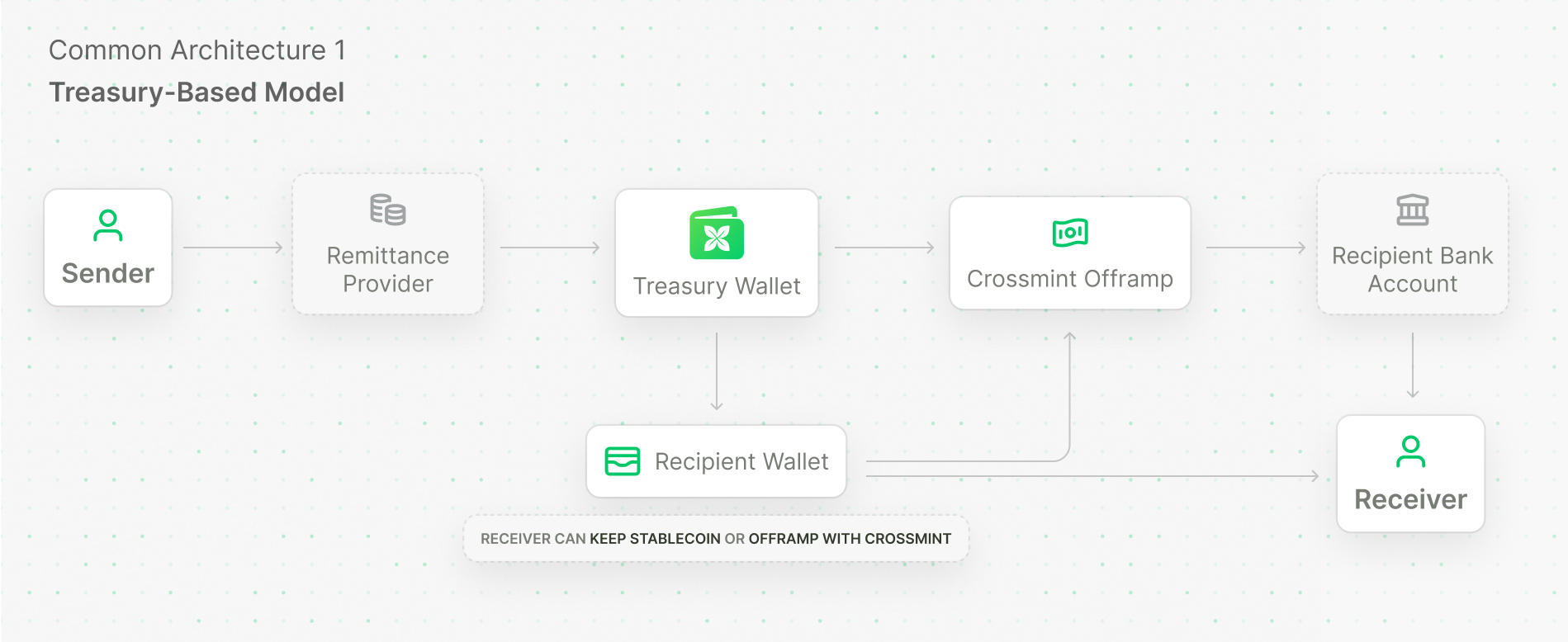
#### Treasury-based model
In this model, the remittance provider receives fiat from senders and converts it into stablecoins, which are held in a centrally managed treasury wallet. You can pre-fund the treasury to enable instant payouts, or convert to stablecoins real time. Best for existing remittance providers without a sender wallet.
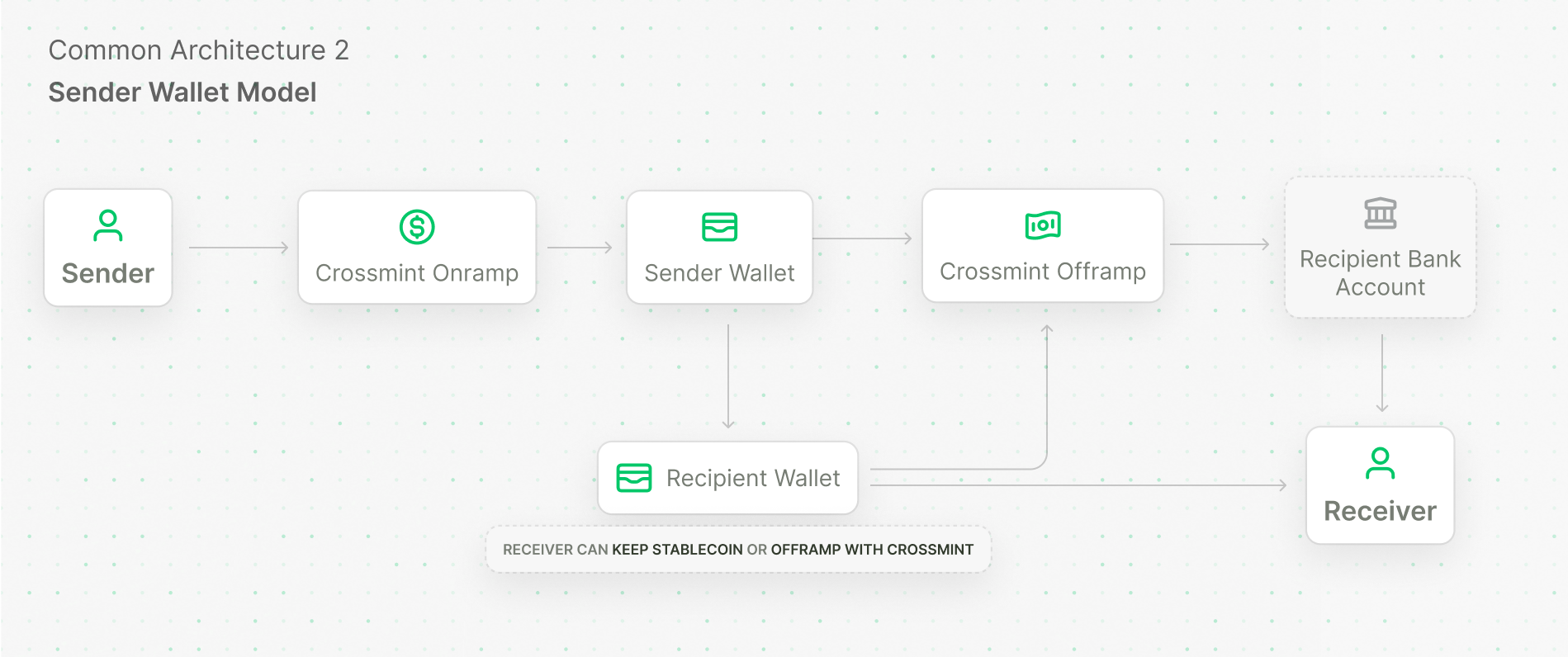
#### Sender wallet model
Senders first fund a wallet, then initiate transfers from their balance. This introduces an extra step, but unlocks additional capabilities: in-app balances for senders, peer-to-peer transfers, recurring or programmable payments, and a broader wallet-based product offering. Best for wallet-first companies.
### 2. How recipients receive funds
#### Fiat payout
Stablecoins are used purely as the settlement rail. Funds are automatically converted to local currency and delivered via bank transfer, mobile money, or cash pickup.
#### Stablecoin payout
Recipients receive funds directly into an embedded wallet. This lets them hold USD-denominated value, hedge against local currency volatility, earn yield, or cash out on their own terms—while unlocking new revenue streams for you. Wallets can be pre-generated, so recipients don't need to sign up before receiving funds; they simply log in and see their balance instantly.
### Combining these modules
These models are fully composable and can be combined to support different remittance flows, for example:
* Treasury-based funding → stablecoin payouts (most common)
* Treasury-based funding → fiat payouts
* Sender wallets → stablecoin payouts
* Sender wallets → fiat payouts
 Need a custom flow for your use case? Our team can help you design, build, and optimize it end-to-end. [Reach out to set up a personalized consultation](https://www.crossmint.com/contact/sales).
## Solution Components
Crossmint's platform provides all the building blocks needed to implement any of the architectures above via simple APIs. Key solution components include:
Create treasury wallets to manage your own funds.
Create wallets for your users: receivers and/or senders.
Fund your treasury with stablecoins.
Embed a widget on your app and allow users to fund their wallets.
Send stablecoins to third-parties using Crossmint's licenses, with built-in AML, sanctions and travel rule checks.
Convert stablecoins to local currency and deliver to bank accounts, mobile wallets, or local payment rails across key remittance corridors.
## Get Started
Contact our sales team to request a consultation to help you design and integrate.
Need a custom flow for your use case? Our team can help you design, build, and optimize it end-to-end. [Reach out to set up a personalized consultation](https://www.crossmint.com/contact/sales).
## Solution Components
Crossmint's platform provides all the building blocks needed to implement any of the architectures above via simple APIs. Key solution components include:
Create treasury wallets to manage your own funds.
Create wallets for your users: receivers and/or senders.
Fund your treasury with stablecoins.
Embed a widget on your app and allow users to fund their wallets.
Send stablecoins to third-parties using Crossmint's licenses, with built-in AML, sanctions and travel rule checks.
Convert stablecoins to local currency and deliver to bank accounts, mobile wallets, or local payment rails across key remittance corridors.
## Get Started
Contact our sales team to request a consultation to help you design and integrate.