

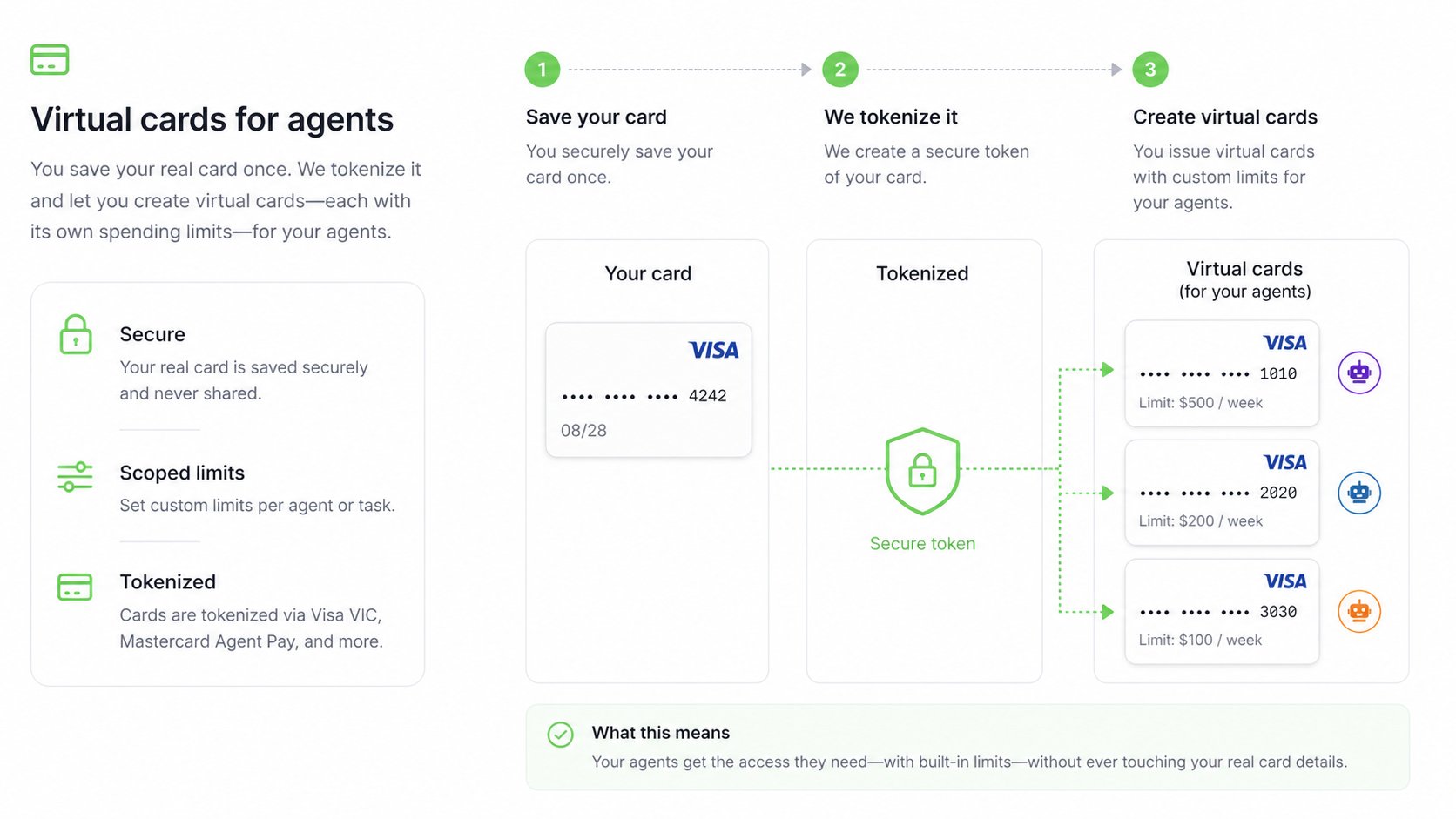
Key Features
Save once, authorize many
One saved card backs any number of scoped agent cards
Scoped by design
Every agent card has an amount, a purpose, an expiration, and optionally a merchant
Enforced by the network
Visa Intelligent Commerce and Mastercard Agent Pay hold the limit, not your code
Real card never exposed
Agents receive one-time or encrypted credentials from a PCI-compliant vault
Multiple rails
Network tokens, encrypted card, and protocol credentials such as SPT from the same authorization
Revocable
The user cancels an agent card or deletes the saved card at any time
How It Works
1
The user saves a card once
Your app renders a Crossmint-hosted secure iframe. The card goes straight into Crossmint’s PCI-compliant vault and never touches your servers.
2
You create scoped agent cards from it
Each agent card is an order intent: an allowance with an amount, description, expiration, and optionally a merchant. Create one per agent, per task, or per purchase. The user approves it with a passkey or a network-hosted step, and can cancel it at any time.
3
The agent pays on the right rail
From an approved agent card, the agent mints the credential the purchase needs: a one-time card number bounded by the allowance, an encrypted card for cards outside the network programs, or a protocol credential. A network-issued credential is bounded to the allowance, expires, and is revoked with the agent card. The encrypted card is the saved card itself, so keep the purchase within the allowance and cancel the agent card when it is no longer needed.
Rails
One agent card can mint credentials on several rails. Pick the rail the purchase needs; the rest stay unused.
Depending on the rail, the credential is delivered as a one-time card number, a network token, or a protocol-specific format such as MPP.
Get Started
Quickstart
Run the reference app: sign in, save a card, authorize an agent card, and mint a credential
Try the live demo
See the full flow without setting anything up locally
Guides
Save a Card
Collect a user’s card in a PCI-compliant iframe
Register a Card
Discover the rails a saved card supports
Create an Agent Card
Create and authorize a scoped order intent
Retrieve Secure Card Numbers
Mint a credential from an approved agent card
Customize UI
Style the approval modal to match your brand
Cancel Card Access
Cancel an agent card or delete a saved card
API Reference
Payment Methods
Create, list, and delete saved cards
Order Intents
Create, mint credentials from, and revoke agent cards
FAQs
Does the agent ever see the user's real card number?
Does the agent ever see the user's real card number?
No. The agent receives a one-time card-network credential minted for a specific amount, or, when no network rail is available, a copy of the saved card encrypted to a key the agent controls. The real card stays in Crossmint’s PCI-compliant vault.
Do your users keep their rewards, refunds, and chargeback rights?
Do your users keep their rewards, refunds, and chargeback rights?
Yes. Every purchase runs on the user’s own card, so the card’s normal protections apply. Nothing is prefunded and no new account is opened.
What happens when a card supports neither Visa Intelligent Commerce nor Mastercard Agent Pay?
What happens when a card supports neither Visa Intelligent Commerce nor Mastercard Agent Pay?
The agent card includes an encrypted-card rail. Minting from it returns the saved card encrypted to a public key you supply, so the agent can still pay while the card details stay out of transit logs. In production this rail is available only for projects with encrypted card access enabled.
Can an Agent Card pay inside an Agent Checkout?
Can an Agent Card pay inside an Agent Checkout?
Yes. Agent Checkouts accepts any method the merchant supports, and a Crossmint Agent Card is the recommended one. See Authorize Payments.